Local Governments Responded
In 2017, the International City/County Management Association (ICMA) conducted its Alternative Service Delivery Survey. 2,343 local governments responded nationwide.
This map aggregates responses to the county level for geographic clarity. Each highlighted boundary represents one of the 1,225 counties where at least one local government participated.
Who Has Outsourced Public Services?
The survey cataloged 67 public services, from road maintenance to public safety, and tracked how each is delivered: by government employees, for-profit contractors, nonprofits, franchises, or volunteers.
The answer is: nearly everyone. Across 1,225 counties, 1,136 have at least one service delivered through alternative mechanisms. Privatization is not binary but a spectrum: some communities outsource a handful of services, while others contract out the majority.
But what happens to citizen participation as more services move outside government? Does outsourcing silence the public voice, or can something anchor it?
Zooming In:
Who Co-Produces?
The same ICMA survey also asked about citizen co-production: whether local governments involve citizens in planning, designing, delivering, and assessing public services.
572 counties provided co-production data. Within these counties, 738 individual jurisdictions (625 cities and 113 counties) responded, and the underlying analysis examines each jurisdiction separately.
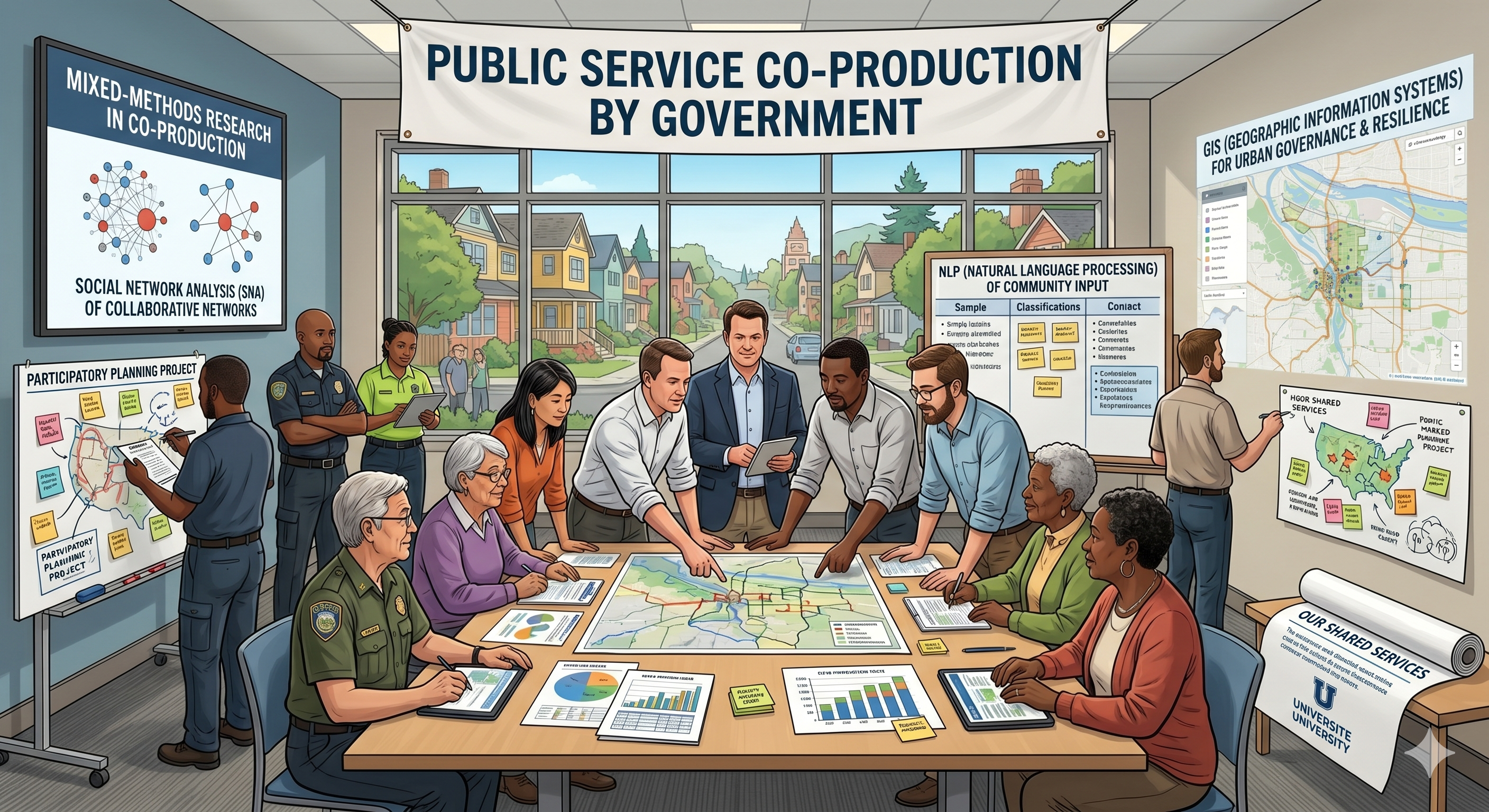
Citizens as Partners, Not Just Clients
Co-production is when citizens don't just receive services; they help shape them. They sit at planning meetings. They help design programs. They volunteer alongside city workers. They evaluate whether services are actually working.
It's democracy in action, not just at the ballot box, but in the everyday work of running a city.
We explored co-production across four stages of the service lifecycle (planning, design, delivery, and assessment) and examined who local governments co-produce with: organized civic groups or individual citizens. Let's walk through what we found.
Co-Planning
The most common form of co-production. The vast majority of responding local governments engage citizens at the planning stage, identifying problems, setting priorities, and defining community needs.
But who do they co-plan with? Not all partners are equal. Organized civic groups are the most common partner, while individual citizens, unaffiliated residents without organizational backing, participate the least.
Co-Design
Beyond identifying problems, citizens help decide how services will be arranged or organized. Co-design involves shaping program structures, selecting delivery methods, and setting service standards.
This stage demands more from participants: understanding budgets, regulations, and trade-offs. Yet participation remains high, with organized civic groups again leading the way.
Co-Delivery
This is hands-on. Many local governments partner with citizens in service delivery: neighborhood watch patrols, community clean-ups, tutoring programs run with city support.
It's the most visible form of co-production, but participation is dropping compared to the earlier stages. Not every community has the capacity, or the institutional support, to make this work.
Co-Assessment
The final stage. Citizens evaluate whether services are actually working. Did the new recycling program reduce waste? Is the contracted road maintenance actually filling potholes?
This is where the feedback loop closes, but it's also the least common stage. Accountability is hard to practice when services are spread across multiple private providers.
Does Privatization Alone Explain It?
Here's what surprised us. When we looked at the data, privatization by itself neither helps nor hurts citizen co-production. Communities that outsource heavily and those that don't show similar levels of co-production.
For decades, scholars have debated whether privatization helps or hinders citizen participation. But what if neither camp is asking the right question?
What if citizens need institutional support to stay engaged in a privatized service environment? Could there be anchors that sustain participation even when services are outsourced?
Could Institutional Infrastructure
Be the Missing Link?
In privatized governance, citizens face fragmented service providers, unclear accountability, and complex contractual structures. We examined whether institutional infrastructure could moderate the relationship between privatization and co-production.
We identified three dimensions:
Epistemic infrastructure: translating complex policy into accessible knowledge.
Relational infrastructure: convening diverse stakeholders in neutral settings.
Physical infrastructure: providing spaces and organizational resources to sustain civic engagement.
The Unexpected Anchor: Universities
Look at the yellow dots appearing on the map. Each one marks a county where at least one four-year university is present.
Here's what we found: when a university is present, privatization actually boosts citizen co-production. Without a university? Outsourcing has no measurable effect. With one? The relationship flips positive.
Universities act as institutional anchors, providing the knowledge, neutral spaces, and organizational capacity that citizens need to participate in a fragmented service landscape.
It Was Never About Privatization Alone
The debate was never really about whether privatization is good or bad for democracy.
It was about whether we invest in the institutions that keep democracy working, no matter who delivers the services.
The Early Stages Are the Hardest
The university effect is strongest at co-planning and co-design, the stages where knowledge barriers are highest. These are the stages where citizens need to understand complex policy, navigate competing interests, and propose viable solutions.
By the time we get to co-delivery and co-assessment, the barriers shift from knowledge to logistics. You don't need a professor to help you pick up trash in a park. But you might need one to help you challenge a city's budget priorities.
It's the Lone Citizens Who Need It Most
In privatized environments, university presence significantly increases the participation of individual citizens, by providing neutral meeting spaces, translating complex policy into accessible knowledge, and lending credibility to citizen-led initiatives. For organized groups, the effect is not significant; they can mobilize on their own. It is the lone citizens who benefit most from institutional anchors.
Organized groups, like neighborhood associations or civic organizations, can navigate privatized governance on their own. They have resources, networks, and institutional know-how.
But individual citizens, the unaffiliated resident trying to have a say, face enormous barriers. They don't know which agency to contact. They lack the time to decode bureaucratic processes.
Outsourcing Without Anchors
Leaves Citizens Adrift
This is the lesson for policymakers: you can't just outsource services and expect participation to take care of itself.
Without universities as institutional anchors, privatization creates a governance vacuum where citizens lose their voice. The contracts get signed, the services get delivered, but the public is left on the outside looking in.